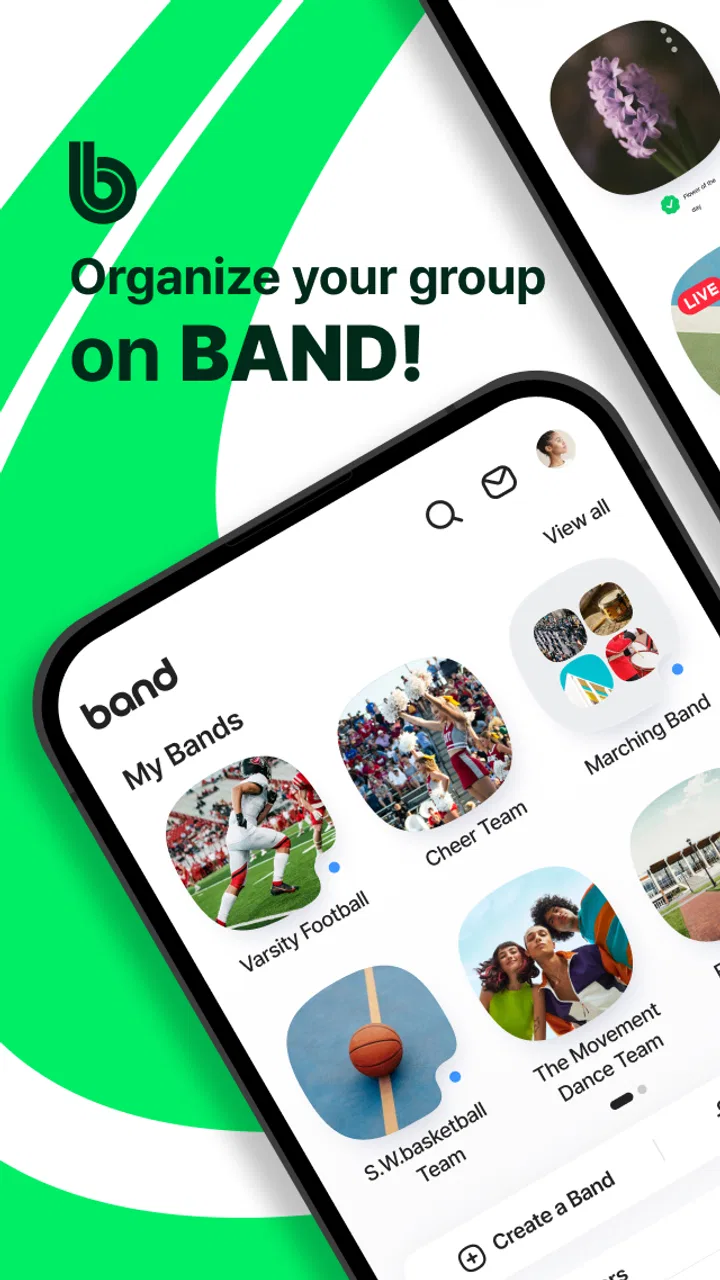
BAND - App for all groups
- 4.8
- Rating
- 50.00M
- Installs
- Free
- Price

 Analysis by App-foxy
I came away from BAND thinking of it less as another casual social feed and more as a shared workspace for groups that need to stay coordinated. The app comes from NAVER Corp. and is free to install, with optional purchases listed from around $1.68 to $53.09 per item. Its central idea is simple: bring a team, club, class, family, or activity group into one organized place instead of scattering conversations across unrelated chats.
That distinction matters most when a group has more to manage than quick messages. A weekend sports team may need announcements, schedules, attendance, and discussion. A school group may want a single place for reminders and files. A family could use a private space for plans without mixing them into a general social timeline. In my experience, BAND works best when the group has a recurring reason to return, rather than when people only need a one-off conversation.
How BAND feels when your group depends on a connection
The app’s social experience is naturally tied to connectivity. Reading new posts, checking updates, responding to members, and keeping up with group activity all depend on communication between the app and its online service. That makes the quality of the experience vary with the moment: on a reliable connection, BAND feels like a tidy meeting point; during interruptions, it becomes harder to know whether an action has completed or whether the latest information is available.
You May Also Like

 AccuWeather: Weather Radar
AccuWeather Review: A Quick, Clear Forecast for Everyday Decisions
For everyday plans, the best forecast is the one you can understand quickly. AccuWeather makes rain timing, radar, and local conditions easy to act on, with a few trade-offs.

 Hill Climb Racing
Why Hill Climb Racing Still Turns Crashes Into One More Run
A tiny car, a bumpy hill and one more upgrade: Hill Climb Racing keeps resurfacing because its simple chaos makes every near-miss feel personal.

 AliExpress - Shopping App
AliExpress Makes Global Shopping Feel Personal, but Shoppers Bear the Risk
AliExpress turns a global marketplace into a pocket-sized discovery engine. Its reach is useful, its shopping loop compelling, and its trade-offs easy to miss.

 Lords Mobile: Kingdom Wars
Lords Mobile Is a Kingdom-Building Routine, Not a Quick Match
A case-by-case verdict on the building, battles, device demands, and social commitments that make Lords Mobile rewarding for some players and exhausting for others.

 PDF Scanner app - TapScanner
TapScanner Makes Paperwork Easier to Capture, Check, and Share
TapScanner makes scanning with a phone feel less like a rescue operation and more like a dependable step in getting work done. Its capture tools are useful, though not flawless.

 Block Blast!
 Shows How Much a Puzzle Game Can Leave Out
A quiet grid game shows why puzzle players increasingly value instant clarity, repeatable skill and low-pressure play—and where the genre still needs to catch up.
More From Our News Desk
View All News


I would not treat it as a replacement for a phone call when something is urgent. A group announcement can be useful, but a member who is temporarily disconnected may not see it right away. For ordinary coordination, that is manageable. For last-minute changes, I prefer to make the urgency clear in the message and use another contact method when the situation genuinely cannot wait.
This is one of the app’s important trade-offs. A conventional group messenger often feels faster for rapid back-and-forth conversation, while BAND is more comfortable when information needs to remain attached to a particular group and be found again later. The difference becomes obvious after several weeks: a busy chat can bury an old detail, whereas a group-oriented structure encourages people to return to the same shared space.
There is also a human factor. BAND is only as useful as the group’s habits. If nobody checks the group, a carefully written update still fails to reach the right people in time. Before moving an established team onto it, I would agree on a simple routine: where urgent notices go, where regular updates belong, and how often members should check in. That small agreement prevents the app from becoming one more neglected notification source.
Why a group space can beat an ordinary chat
The strongest reason to choose BAND is separation. Instead of mixing a club’s conversation with personal messages, the group has its own context. That helps when someone joins several activities or when a family member also participates in a community group. I found that this separation reduces the mental effort of figuring out why a notification matters.
It is particularly useful for groups with different kinds of communication. A short announcement, a planning discussion, and a recurring activity do not always deserve the same treatment. In a normal chat, all three can become part of one long stream. BAND’s group-first approach makes more sense for people who want their shared activity to feel like a small organized community rather than a constantly moving conversation.
That does not mean it will suit everyone. If your friends only exchange quick jokes and immediate replies, a familiar messenger may feel more natural. BAND asks users to accept a little more structure, and structure is helpful only when the group actually needs it.
Using it during ordinary mobile moments
I see the app fitting naturally into short checks throughout the day. A coach can post an update before practice, members can review it while commuting, and someone can return later to confirm the details. A parent can check a group notice between errands instead of searching through several personal chats. A volunteer group can keep its discussion in one place while members respond whenever they have a suitable moment.
The phone format is convenient for these brief visits, but it also creates a temptation to treat every notification as equally important. My practical advice is to establish a predictable rhythm rather than reacting to every alert. Check the group before an activity, after a meaningful update, and when you have enough time to read the surrounding context. That approach is less distracting and reduces the chance of replying to an incomplete thread.
On a small screen, context can disappear quickly. A message that seems clear by itself may depend on an earlier post, a date, or a decision made elsewhere in the group. I make a habit of opening the surrounding conversation before acting on a logistical update. It takes a few seconds and is especially worthwhile when several events are being planned at once.
For mobile users, the real benefit is not simply having group communication in a pocket. It is being able to return to the same group identity wherever the day takes you. That continuity is useful for people who move between home, work, school, and activities. Still, it should not be confused with guaranteed availability: a phone can be in your hand while the network is weak, congested, or unavailable.
A realistic weekend team workflow
Imagine a recreational team preparing for a Saturday event. Earlier in the week, the organizer posts the meeting details. Members read the update, ask questions in the group, and check back as the plan becomes clearer. On the morning of the event, one person notices a change and posts it. Someone else is already traveling and may not see that change immediately, so the organizer repeats the most important point in a direct message or another agreed channel.
Afterward, the same group can remain useful for the next event instead of starting from zero. That is where BAND feels more valuable than a disposable chat: the group has an ongoing identity and a reason to preserve its communication. The workflow succeeds because the members understand which information belongs there and because they do not assume that every participant is watching the screen continuously.
For a family, the scenario is different but the principle is similar. A shared group can hold plans for a visit, reminders about an appointment, and updates during a trip. The advantage is keeping the family context together. The limitation is that older relatives or less frequent users may need a clear explanation of where to look and what kind of message deserves a response.
What happens when a connection fails
Connectivity problems are most frustrating when the app is used for coordination. You may open a group expecting the newest information and find that the view is not current, or you may send a response without immediate confidence that everyone can see it. I avoid making important decisions based on an update until I know the group has had a reasonable opportunity to receive it.
A good recovery routine is simple. First, stop repeating the same action rapidly; multiple taps can create confusion about what actually went through. Next, check whether the connection has returned and revisit the group before posting again. If the message affects timing, safety, travel, or attendance, confirm it through a backup channel rather than assuming the app will resolve the uncertainty.
Group leaders should plan for this before an event. Put the essential meeting point and time in a clear post, avoid hiding a critical change inside a long discussion, and make sure members know how urgent updates will be handled. This is not a flaw unique to BAND; it is a general reality of mobile group communication. The app is strongest when it supports a communication plan instead of being the entire plan.
Recovery also includes social cleanup. If a delayed connection causes several duplicate messages, summarize the final decision in one short update. That helps members who reconnect later and prevents the group from becoming difficult to follow. In my view, this is one of the most useful habits for any BAND administrator: when circumstances change, publish the current answer clearly instead of expecting everyone to reconstruct it from the thread.
Keeping mobile data and attention under control
Because BAND is built around active group communication, frequent checking can consume more than just attention. It may also use mobile data as you load updates and any shared material. I would not assume that every group is equally light on data, especially if members regularly exchange media or return to the app throughout the day.
For a limited data plan, the sensible approach is behavioral rather than complicated. Use a stable connection when you expect to catch up on several updates, avoid repeatedly opening the app just to see whether anything changed, and leave nonessential browsing for a time when data use is less of a concern. These habits also make the experience calmer.
Group organizers can help by keeping announcements focused. A concise update is easier to read, easier to act on, and less likely to trigger a long chain of clarifying replies. If a topic needs detailed discussion, keep the decision itself visible so that members do not have to reread every message. This is a small design choice from the group, but it has a direct effect on mobile convenience.
Privacy and attention are connected here as well. Before joining or creating a group, I would consider who genuinely needs access and whether the group has a clear purpose. A smaller, focused membership usually produces more useful notifications than a broad group where many people are only loosely involved. The app can organize a community, but it cannot decide which conversations deserve your time.
Who should use it, and who should look elsewhere
BAND is a strong match for recurring groups: sports teams, hobby clubs, study circles, volunteer organizations, families, and other communities that need more continuity than a simple message thread provides. It is also appealing to people who belong to several groups and want each activity kept in its own space.
I would be more cautious if your priority is instant, informal conversation above everything else. A standard messenger may feel quicker for a small circle that rarely needs announcements or organized follow-up. I would also hesitate to rely on BAND alone for emergencies, time-critical changes, or situations where some members may be offline for long periods.
The app is free, which makes trying it with a small group straightforward. Optional in-app purchases are available, so I would discuss whether the group actually needs them before anyone spends money. The free entry point is enough to evaluate the basic workflow: create or join the relevant group, establish communication habits, and see whether members return consistently.
Its Teen content rating is worth keeping in mind when the app is introduced to younger members. A group leader should still set sensible expectations around respectful communication, personal information, and who is included. A rating is not a substitute for supervision or good group rules.
Version, reach, and everyday confidence
The current version is 27.0.2, and the app requires at least OS 10. That makes checking device compatibility an important first step, particularly for older phones in a family or community. When one member cannot install or update the app, the group’s communication plan needs an alternative rather than assuming everyone can participate equally.
The app has been available since Aug 7, 2012, and its scale is reflected in more than 50 million installs. It holds an average rating of 4.8 from around 657 thousand ratings, with roughly 6.9 thousand written reviews. Those figures suggest broad adoption, but they do not remove the need to judge it against your group’s actual behavior. A highly rated group app can still feel wrong if your members prefer spontaneous chat.
What I trust most about the experience is the clear fit between the product and ongoing communities. What I question is the assumption that organization automatically creates participation. The group still needs a person who posts useful updates, members who check them, and a backup method for moments when connectivity gets in the way.
My connectivity verdict
I recommend BAND when your group needs a persistent online home and can agree on how to use it. It is more purposeful than a loose social feed and more structured than an ordinary chat, especially for recurring activities with announcements and follow-up. The mobile experience makes quick checks practical, but the app works best when users understand that network access and attention are part of the equation.
My final advice is to test it with one real group rather than moving every conversation at once. Choose a team or club with a clear weekly need, define what belongs in the group, and decide how urgent changes will be communicated if someone is disconnected. If members find that the shared space reduces confusion, BAND is earning its place. If they keep returning to another messenger for every important exchange, the structure may be more than they need.
For people who want a focused space for a continuing community, this is a thoughtful choice from NAVER Corp. For people seeking only rapid one-to-one messaging or a purely casual social stream, another option may feel lighter. The best reason to choose BAND is not its size or its rating; it is the way it gives a real group a dependable place to organize, provided everyone knows when and how to check in.
FAQs for BAND - App for all groups
01What is BAND and who is it for?
BAND is a versatile communication app designed for groups, whether it's for families, friends, work teams, or hobby clubs. It offers features like group messaging, calendars, polls, and file sharing, making it ideal for anyone looking to stay organized and connected within a group setting.
02How does BAND handle privacy and security?
BAND prioritizes user privacy and security by implementing strong encryption for messages and data. It allows group admins to control who can join and participate in the group, ensuring that only authorized members have access to shared information. Additionally, BAND does not share user data with third parties without consent.
03Can BAND be used for business purposes?
Yes, BAND is suitable for business use. It provides tools for team collaboration, such as task assignments, shared calendars, and document storage. These features help improve team communication and productivity, making it a viable option for businesses seeking an organized platform for managing projects and team interactions.
04Does BAND support multimedia sharing?
BAND supports a variety of multimedia sharing options. Users can share photos, videos, and files within their groups. This feature is particularly useful for sharing event pictures, important documents, or any media that helps enhance group communication and engagement.
05Is BAND available on both Android and iOS?
Yes, BAND is available for both Android and iOS devices. Users can download the app from the Google Play Store for Android devices and the Apple App Store for iOS devices. This cross-platform availability ensures that users can stay connected with their group members regardless of their device.
Pros
- Easy group chat setup for teams.
- Customizable notifications for events.
- Supports polls for quick decisions.
- Integrates with Google Calendar.
- User-friendly interface for all ages.
Cons
- Limited file sharing options.
- Ads can be intrusive at times.
- Requires internet for full use.
- Limited customization of themes.
- No desktop version available.

BAND - App for all groups
Gallery